
Curved monitor? Me want! *drool*
Recently somebody left the following spam on my Facebook FunWall.
Attention all Facebook membeRs.
Facebook is recently becoming very overpopulated,
There have been many members complaining that Facebook
is becoming very slow.Record shows that the reason is
that there are too many non-active Facebook members
And on the other side too many new Facebook members.
We will be sending this messages around to see if the
Members are active or not,If you're active please send
to other users using Copy+Paste to show that you are active
Those who do not send this message within 2 weeks,
The user will be deleted without hesitation to create more space,
If Facebook is still overpopulated we kindly ask for donations but until then send
this message to all your friends and make sure you send
this message to show me that your active and not deleted.
Founder of Facebook
Mark Zuckerberg
How can people fall for such crap? Whatever happened to the skill of critical thinking? This particular hoax, “Overload of Malarkey” has been up on Snopes for ages — the old “Please forward this message to as many people as possible or your Hotmail account will be deleted” hoax, only this time retooled for Facebook. This basic hoax has been around since at least 1999 and he Facebook version since December 2006.
I mean, I know most people have little or no understanding as to how computers and the Internet actually work, but are people really that gullible as to think that the founder of such a booming company as Facebook would actually send out a message with such atrocious grammar? Think, people. Think!
Back in June I started upgrading my computer cetifications at triOS College in downtown Kitchener. A+, MCSE and the like.
One thing I wish I had done was keep track of stupid questions my classmates have asked — they would have made great blog-material. At the very least, blogging it all would have made banging my head on the desk every day worth something.
The current course is 70-298, "Designing and Implementing Security for a Microsoft Windows Server 2003 Network" and by now all people in my class have take at least one of the A+ courses a well as, Network+, 70-270 (Windows XP) and five other Windows Server 2003 courses. But today, as we were going over the mini-project from yesterday setting up IPSEC policies and filters (firewall stuff, deciding what gets through, what is encrypted, what is clear, etc...). Of the various settings we had to do in the filters was make sure that Windows File Sharing traffic was encrypted and FTP traffic was blocked.
As the instructor was going through creating the filters, one of my classmates asked “What is the difference between FTP and File Sharing? Aren't they the same thing?” After six months, you'd think that he'd know the difference by now.
In the past few weeks I've gotten friend requests on Facebook from people whom I do not know. And I don't mean people that I haven't seen in ages that I may have forgotten, I mean people I have never met — in Real Life™ or on-line.
All three of these people have in their profile in interests the exact same advertisement for this "SCHOLARSHIP4FREE" website.
The friends lists of these three people are abnormal, too. If you're familiar with Facebook, you know that one can limit which parts, if any, of your profile which people can see based on whether or not people are on or not on your friends list. You can also pick specific people and limit what they can individually see. So if you take a random person on Facebook and list their friends, a little bit more than half the Names will be links to their profiles and the other (slightly less than) half will not be links because they have made their profile private, visible only to approved friends. In these spam-peoples' friends lists, not a single one has a visible profile. One oddity.
The average person also has a large number of their Facebook friends in one network, usually the same network they themselves are part of. For the first two spam-people who sent me a friend request, each and every one of their friends was in a different network and these networks were so widely scattered across the globe that it seems a rather unlikely list of friends. This third spam-person, who's friend request came to me today, has two friends in one network, but all the rest are each in a different network. Nor were of these spam-people from whom the friend requests came actually in a network themselves. Second oddity.
From the 8th through the 15th I had holidays from school, and since I was so bored I took one of the these spam-people and wrote down “her” list of friends and then I went through the friends of those friends and then the friends of the friends of the friends, a total of four levels. For us real people, our friends usually know each other and everybody in the group is in each other's friend list. Not so for these spam-people. None of their friends knew each other and it was the rare friend of a friend of a friend who had another friend of a friend of a friend in their friend list. Third oddity.
Any single one of those three things would be unremarkably odd. I know a bunch of people on Facebook who haven't placed themselves in a network — yet most of their friends are in the same network and they know each other. I'm sure there are some well travelled people who have friends and acquaintances all over the globe, yet again there are clusters of friends in the same network and some level of common friends. Ball these things together plus the spamvertisement? It's just too much a coincidence.
They have got to be false networks of friends set up under false pretenses that randomly send friend requests to real people. The real people go “Hunh? Who's this?” and look up the profile for a clue. Et voilà, they have seen the spam!
The odd thing is, I have been thinking of writing a “Facebook crawler” that would trace friend-links for either a “Seven Degrees Of…” game, or to us the data in an OpenGL program that would create a three-dimensional graphical web of how people are connected. I guess somebody got there ahead of me and decided to use it for nefarious purposes. :-P
A few months ago my LinkSys WRT54G was giving me trouble. Somehow it was fighting with the wireless NIC in my OpenBSD firewall where by for periods of just a couple to twenty minutes I would have no wi-fi connectivity at all. Not even from my new laptop direct to the WRT54G, by-passing the firewall, did I have any bandwidth. Usually it did that 2 or 3 times a day, though some times not for a couple days and occasionally 6 or 8 times in an evening. When that wasn't happening, something the router cause the firewall's ARP lookup tables to fill which prevented it from route packets and the computers behind it would lose Internet connectivity. Sometimes I could just reset the NIC, other times I had to reboot the firewall.
Eventually I got so frustrated at the damn thing I took the WRT54G out of the loop and set up the firewall so it's wi-fi NIC woudl act as the base station for my latop and pocketpc, in place of the WRT54G.
Anyways, almost two week sago, out of boredom (and tripping over the cord one too many times, again, I guess), I reconnected the WRT54G just to see what would happen. Lo and behold, I have had no connectivity issues with it at all!
Since the WRT5G is now over a year old I decided to replace it's stock LinkSys firmware with OpenWRT — a Linux distro especially designed for embedded situations like routers. For exmaple, my WRT54G has a mere 16MB of RAM and a paltry 8MB (yes, merely mega bytes, not gigabytes) of flash RAM for “permanent” (surviving reboots) storage.
In spite of the platform limitations, I am quite impressed with OpenWRT in how many features it has. One example, is iptables, a common Linux firewall mechanism which is much more powerful than the simple firewall offered by the stock firmware's web interface. Another is the fact that I was able to add IPv6 networking to the WRT54G and run the IPv6 tunnel client from go6.net.
As cool as it is to have OpenWRT Linux running on my router, though, I can't say that it will ever be able to replace OpenBSD running on a real computer as a firewall. But being able to put IPv6 on a consumer router you can get at Future Shop $100 instead of $800 for a low end Cisco switch? Can't beat that.
This past week, on and off, I've noticed somebody hammering at my wi-fi trying to get acess. And it's not like they are trying anything overly intelligent to get in, just request after request after request for a DHCP address. Now I have things limited to a handful of specific MAC addresses so they aren't getting in, so I'm not terribly worried about them stealing my bandwidth. But then I remembered this website: Upside-Down-Ternet
Well, it looks like the outcry against Microsoft's more restrictive licensing as to how many time you may reinstall Vista was actually heard by the software monopolist giant. A product manager at Microsoft posted this to the Windows Vista team blog yesterday.
By now everybody knows that the next version of Microsoft's Windows operating system, Vista, will be out soon. What most people don't know is how restrictive the new End-User License Agreement is for Vista. If you thought that Microsoft's court battles against various governments over its monopolistic desires made them soften up, read this article by Scott Granneman.
As an example, one if things the new EULA restricts is how many time you may reinstall Vista. It used to be that as logn as you only had it running on one computer at a time, you could reinstall it as often as you wanted — like if you bought a new computer. But the new EULA only allows you to install it twice. Yup, only twice. Say you buy Vista in January when it comes out and then you get a new computer a few months later, moving Vista to it. In a few years when you next upgrade your hardware you won't be allowed to install Vista on that one because you all ready used your two times.
This is the first thing that has ever made me think of getting rid of Microsoft software entirely, instead of having it on just one of my 3 computers.
I may be trying out Linux on one of my computers, but I am still a BSD snob at heart. :-) This video was pointed out to me be somebody from #userfriendly on Undernet.
A tongue-in-cheek look at the history and future of the BSD movement. Modeled after the presentation styles of Lessig and Hardt, the talk provides a light-hearted introspection of the leaders, technologies, and community that forges ahead despite having been left for dead some 15 years past.
This presentation was given by Jason Dixon at the NYC BSD Conference at Columbia University on October 28, 2006.
Well, I got around to wiping OpenBSD from my formerly main computer earlier than I thought. (See this previous post.)
Saturday evening I installed Ubuntu 6.06LTS on to my dual P3-450 system which, until April, had been my main computer since 1999.
After getting home from church and lunch at my Mom's place today, my day, and evening, has been spent fiddling around with Ubuntu, learning how Linux is different from BSD and installing packages that I would like to have but weren't part of the Ubuntu base system. Almost the first package I installed (after Firefox and Thunderbird) was the 686-class kernel for SMP capabilities. The default 386-class kernel ran rather sluggishly and (obviously) only used one of the P3-450s. The difference after rebooting was immediately noticeable! I've also decided that I like Gnome (which comes default with Ubuntu) better than KDE for my X11 window manager.
The only major problem I have had so far was with network setup, specifically the file /etc/network/interfaces and the loopback device. I was trying to get the SSH daemon to accept IPv6 connections, since everything on my home LAN is almost all IPv6. Suddenly, after a reboot, I was getting the X login screen supplied by gdm, but after typing in my userid and password the screen would go blank with just a mouse cursor. Nor were any of the character terminals present — just a blinking cursor in the upper right corner in all Ctrl+Alt+F? screens.
The thing is, in *BSD, the loopback interface is called “lo0”, consistent with all other devices — a few letters identifying the hardware and the a number for the Nth device of that type. In Linux, however, it's just called “lo”. If you accidentally turn lo into lo0, like I did, or just remove the setup lines for the loopback device from the interfaces file, the loopback device never gets configure and the entire network subsystem is FUBARed, which in turn FUBARs the entire operating system. In OpenBSD, the loopback device is always there if you have networking compiled into your kernel. Not having a /etc/hostname.lo0 file won't prevent the loopback device from being configured and it won't bring your operating system to it's knees. Indeed, even if you delete all your /etc/hostname.* files, all your server daemons will still start unless you've specifically configured them to bind to a specific address or fail. Technically, your system still works and you don't have to go into single user “safe” mode to fix things because you can't login in normal mode.
Now part if this was my own fault for mixing up what I thought the loopback device's name was. However, I cannot believe that Linux has such a potentially major problem creator in it's network configuration method. I did find a webpage that describes a fail-over and load-balancing network architecture using something called Ultramonkey where you configure additional loopback interfaces with non-127.0.0.0/8 addresses, but I think that OpenBSD's carp is the more elegant situation. No futzing around with carp will prevent your computer from booting properly.
At any rate, we'll just have to see what the future holds and how strongly I maintain my pro-BSD bias as I become more familiar with Linux.
Having had OpenBSD for a number of years on my second computer acting as my firewall, when I got my third computer back in April the idea was to turn my formerly main computer from a Windows maching into a un*x desktop.
My experiences with OpenBSD have shown me that while it makes an excellent firewall or server operating system, because it lags behind in certain key areas (like third party applications support), it's not really the best OS to have for a workstation. This meant that I would have to choose between FreeBSD and some Linux distro, with perhaps Darwin x86 from Apple as a minor contender. Using one of those three operating systems, I would be able to get things like a Flash player, a decent office software system and many other things I could not get on OpenBSD.
Well, as it happened, shortly after converting that formerly main computer from Windows XP to OpenBSD as an interim step, my brand-new Xeon behemoth stopped working. The motehrboard had ba capacitors and had to be RMA'ad back to Asus and that took forever. The first replacement motherboard they sent back, which took 6 weeks, simply would not POST so a second one had to be sent, and that one also took 6 weeks. After talkign to the guy at the computer store I usually shop from, I found out that Asus's support has been slipping dramatically. The 1-800 number they used to phone for RMA info and the like simply no longer worked and they no longer were getting responses back in 24 hurs to email inquiries like they used to. Needless to say, I doubt my next computer will be Asus-based after all this.
So in the mean time, I wasn't about to do a whole 'nother OS installation my once-again-main computer until the Xeon behemoth came back. But never expecting 3 months without it, I got kind of comfortable with the formerly main computer as an OpenBSD workstatin, in spite of what I feel it lacks.
I switched the window manager from WindowMaker to KDE, installed both Firefox and Thunderbird because I disliked KDE's konquereor and kmail apps. I set up NFS shares so that all my MP3s were available to the firewall where I set up two different multimedia servers so I could listen to my MP3s when not at home. The firewall had also been a Samba server and had hosted the home directories for the users with accounts under Windows XP on the formerly main computer, so I moved them over, shut down the firewall's Samba daemon and NFS'ed /home back to it. All in all lots of modifications over the three-plus months I was waiting for the Xeon behemoth to return.
When that day finally came, I just re-integereted it into my home network, started Samba daemon on the former main computer so /home would be available to the Xeon behemoth running Windows XP. And that's how it has been for the last few months.
So today I decided to install the Ubuntu distro of Linux since a number of people I know on-line had recommended it. But where did I install it? Not on the formerly main machine which stil hasp OpenBSD, but onto the Xeon behemoth into the partition which had held Windows Vista RC1 for the past month. :-) I almost feel like a traitor to BSD, installing a Linux distro.
Ubuntu seems nice, and eventually I will wipe the formerly main machine and install it there, but knowing me that will take a few months. Mostly because of all the data which will have to be copied off of the *BSD-type FFS file systems in order to be able to set up proper Linux-type EXT3 partitions for everything. Also, doing all the system administration tasks on Linux rather than on BSD is a little like being dropped in the Scottish hinterlands — you know that they're all speaking English but you can't understand half of it. On the bright side, by the time I do ge around to it, I should know enough about Ubuntu specifically and Linux in general to make the switch over go smoothly in a single day.
Well, as it turns out, I won't have to risk turning my wi-fi router into a brick just to get IPv6 connectivity again!
I'd like to call it a stroke of genius, but somebody else has probably already figure this one out:
For several years I have had an IPv6 prefix to allocate from for my home network and virtually all internal traffic has been IPv6 rather than traditional IPv4. Lately, however, I haven't had access to the IPv6 universe because my tunnel client doesn't like the fact that the OpenBSD host it runs on is behind a wi-fi router and on an IPv4 NAT.
Unfortunately, my apartment is in an older building and I only have one telephone jack and it's right near my front door. Tiny as my apartment is, it still meant cables stretching from there to my desk where my computers live. I got so tired of tripping over the cables that I went and got a Linksys WRT54G router.
The wi-fi router runs wonderfully. I can use my PocketPC with it, and with the router set to DMZ mode and forwarding all ports to my firewall machine there is no difference, IPv4-wise, as when the DSL modem was hooked directly the firewall.
Alas, no such luck with IPv6 connectivity. So while googling for brands of IPv6-enabled wi-fi routers, I find that there are open-source firmware updates for my router. It seems that the WRT54G uses an embedded Linux to run itself and people have made their own versions with expanded functionality. I even found a client specifically for my IPv6 tunnel broker, Freenet6.
So now I have to figure out whether I want to:
Decisions, decisions...
If you get an email from an address like this FirstLast@invitation.sms.ac, don't even bother opening it. It is spam-scam crap.
It looked shady to me the first time I got one and as I have been getting more and more (and always from people on my MSN contact list) I decided to look into it. On one web page about it I found the following:
Also, some person by name of "Sean" has left what appears to be the exact same comment (cut & pasted?) in the followup threads of multiple blogs saying basically "Oh, if you'd just read the terms properly..." as well as insulting people who complain about sms.ac's spam-scam crap.
Not only that, but sms.ac has sent cease and desist letters to bloogers who had posted entries warning people about the spam-scam. Check the list of links below to see what others say about sms.ac.
Whatever you do, do not sign up with sms.ac!
Well, Bill Gates might have finally done it — said something to surpass his "640kB should be enough for anyone" bit. In an article on C|Net news, Gates said:
In terms of our agility to do things on the browser, people who underestimated us there in the past lived to regret that.
In response Ben Goodger, one of Firefox's developers has this to say:
Bring It On
As business savvy as Gates is, he's never been very visionary — as that 640kB line shows — and neither has Microsoft been so. Virtually everything they supposedly pioneered they copied from somebody else. What Gates and Microsoft did do well was utilize their economic leverage gained from being chosen by IBM to provide the operating system for the original IBM PC - the first widely popular home computer.
But Microsoft has never been about what the consumers want — or at least only insofar as it will get them some market share so they can force down the consumer's throat what Microsft things should be like. The 800lb gorilla of the software world but unfortunately not even half a smart as a chimp.
Gates's response to the mention of security and Internet Explorer is to bring up autoupdate and how with that you don't have to think any more. We've all known it for a while, but with that Microsft has finally revealed that they aren't about Where do you want to go today? but really We'll tell you what to think today.
Truly — our only hope is open source.
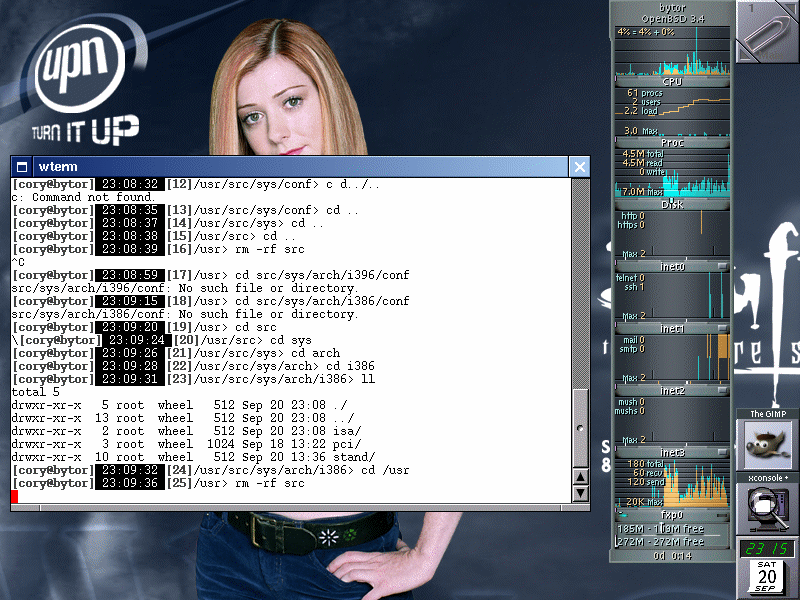
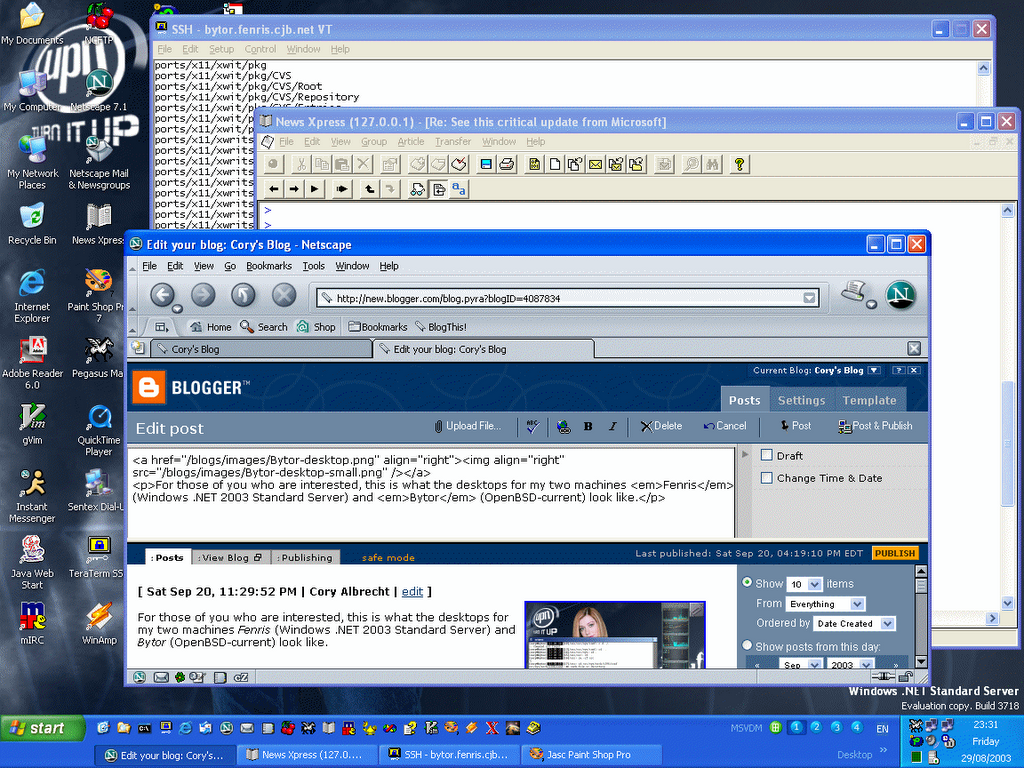
For those of you who are interested, these are what the desktops for my two machines Fenris and Bytor look like.
Fenris runs Windows .NET 2003 Standard Server RC#2 all gussied up to look like Windows XP. (Normally Win2K3 it looks like the old Windows 2000 style.) The desktop is 1152x864, and the programmes running when I took this snapshot were Netscape, News Xpress and TeraTerm SSH.
Bytor run OpenBSD-current (as of 2003/09/28). I use WindowMaker as my window manager for X11R6 in 800x600 mode. The programmes running at the time of the snapshot were WTerm and GKrellM along with iconised The GIMP, XConsole and ASClock.
The saying used to be "If you had an infinite number of monkeys banging on an infinite number of typewriters, they would eventually produce all the works of Shakespeare". Well, that's changed, thanks to the monkeys at Primate Programming™ Inc.. Now, with just a on-infinite number of apes and a bunch of computers you can outsource the production of software tailored to the needs of your organization. And who knows — maybe you'll even get something as good as all the works of the Microsoft Windows programmers.
Open source software — gotta love it. Sometimes, though, I think it's more like "gotta love to hate it". Now don't get me wrong — my other computer (Bytor) runs OpenBSD and I love it. On Bytor I have my development webserver, my mail server(s), a DNS server, a FTP server and my archive directory of almost everything I've ever downloaded, as well as all the home directories for every account on my Windows machine.
I spent this past week upgrading Bytor from version OpenBSD-3.3 to OpenBSD-current in order to take advantage of the latest patches and upgrades made to not only the OS but also any packages I have installed. Part of the reason I spent most of the week upgrading Bytor is because I am behind a normal phoneline, so downloading takes forever. But that wasn't the only reason it took me all week. The major problem with open source, IMNSHO, is documentation or lack thereof. Few programmers like writing documentation and as a result few open source programmes have the amount of documentation that commercial software has.
In my professional opinion as a freelance computer consultant, OpenBSD is simply the best, most reliable and certainly the most secure of all the free un*xes out there. If an organization wants to host their own website, whether it is for only internal use or to be shared with the 'Net, I tell them to take one of their older server or desktop machines and load OpenBSD onto it, add Caucho Resin and MySQL and it will be competitive with a new Windows machine that is twice as fast and has twice the memory, if not better. And for $0 too, compared with potentially $3000 for a new machine plus Windows. That same OpenBSD machine could also be their corporate mail server, and the firewall for their entire office network if they wanted security.
But in spite of this glowing performace report, OpenBSD has less documentation for it than un*xes like FreeBSD or the various flavours of Linux (RedHat, Debian, Mandrake, etc...). It is not really for the casual office or home user, and even for a geek like me it's much better as a server than as a desktop. After you factor ot slow download times via modem, the reason it took me a week to upgrade Bytor was because every time but one I came up against a problem I couldn't find the answer on the OpenBSD site.I had to go search the 'Net and dig through reams of archived mailing list posts to find an answer, and about half the time I had to adapt from answers to similar problems on FreeBSD or NetBSD.
A few years ago in a newsgroup, I posted my opinion that OpenBSD is destined to remain on the margins unless good documentation was produced, and Theo deRaadt (the original force behind OpenBSD) got rather annoyed at me for saying that. At the time I volunteered to produce or coordinate a comprehensive "OpenBSD HandBook" formatted like the FreeBSD Handbook, and I asked how would be the best way to go about getting significant documentation like that started and put on to the OpenBSD website. Except I got no answers, not evan a "So-and-so manages the website, talk to him". When I asked for pointers or URLs on how to go about writing device drivers for OpenBSD, all I got was "RTFM you idiot" Unfortunately there was no (f***ing) manual for OpenBSD device drivers to read, and reading the poorly commented code that was part of the OpenBSD sources helps only if you already know what you are doing. That's when I made my comment about marginalization and then Theo got mad at me (and it made me see why some people call him arrogant). While there are a few more docs on the OpenBSD website 3 years later, it still doesn't approach the level of the FreeBSD Handbook or everything available for Linux. And that's a shame, because OpenBSD is the best free un*x out there.


